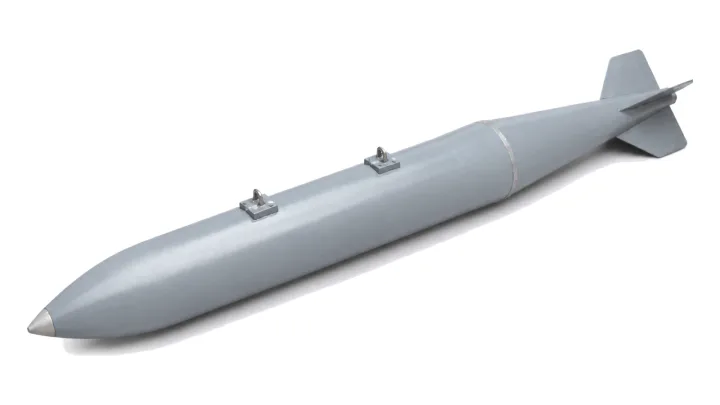
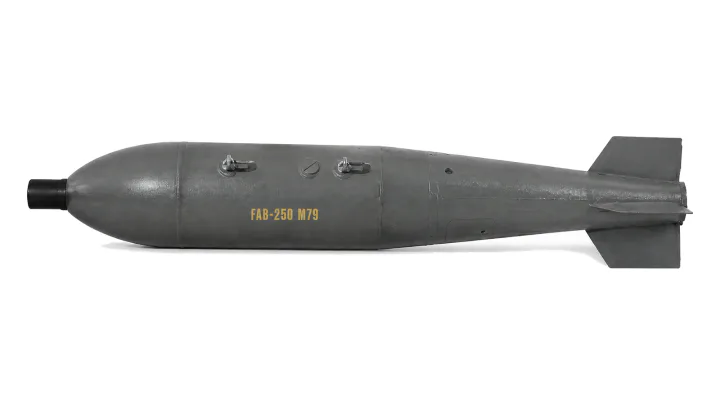
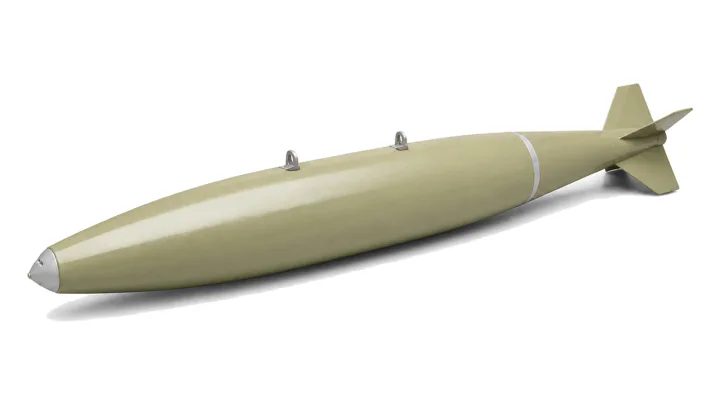
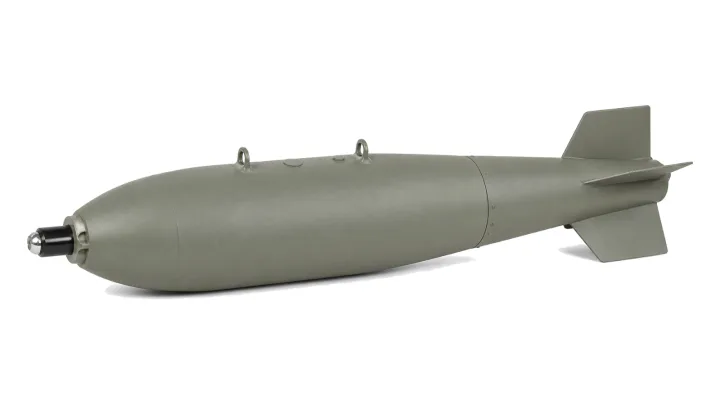
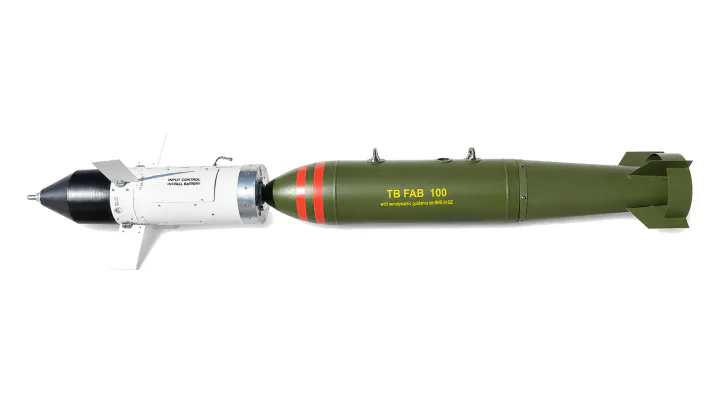
Nine records cover stores released from an aircraft or an unmanned platform. The ballistic bombs are the FAB-100 M80 and FAB-250 M79, the fragmentation RAB-250 M91, the general purpose vFAB-250-2 and vFAB-1000-4, and the hardened penetration vPRAB-1000-9. Beside them sit the 128 mm PGB-128 gliding bomb, the 80 mm LAB-08 multipurpose bomb and the BNB-015IZ aerodynamic guidance kit, which the source describes as converting 200, 500 and 1000 lb bombs into corrected bombs. Masses and fuze or guidance details are given per record; suspension-lug spacing is published on the six ballistic bombs and on the PGB-128.
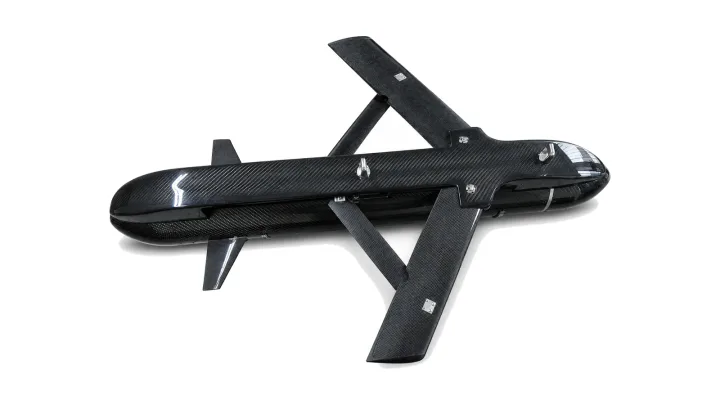
A precision-guided glide bomb of the small diameter bomb category weighing less than 50 kg, guided by GPS-aided inertial navigation against fixed targets and optionally by an added semi-active laser or imaging infrared seeker against moving targets, with a composite airframe, tail cone with all-moving control surfaces and Diamond Back type wings that deploy after release.
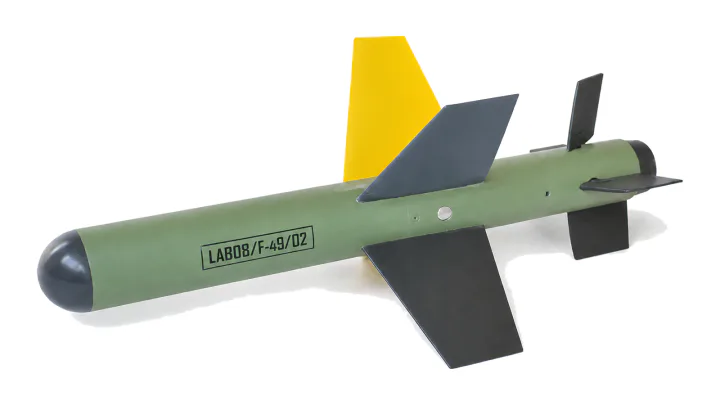
Light multipurpose 10.5 kg guided aerial bomb for launch from a UAV or other aircraft platform, with SAT/INS guidance, optional SAL/ORM terminal guidance, range up to 10 km and interchangeable fragmentation, penetration, shaped-charge/blast and incendiary warheads.
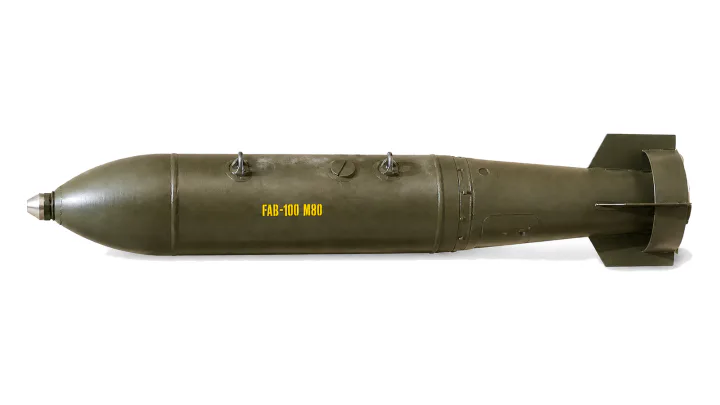
A 117 kg high-explosive free-fall aircraft bomb with a 39 kg TNT main charge, intended for targets of medium fortification level and releasable safe or armed at speeds up to 1000 km/h.
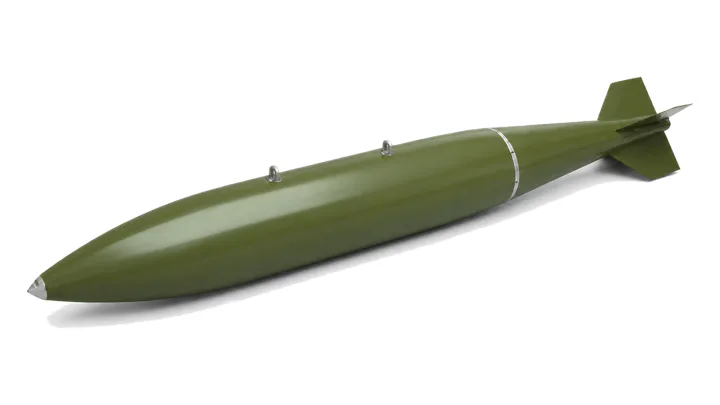
A 1000 kg demolition-fragmentation ballistic aerial bomb that defeats surface and buried objects by shock wave and steel-mantle fragments, supplied with stabiliser, two suspension lugs, protective transport plugs and transport packaging, and usable unguided or as a guided bomb warhead.
A hardened penetration aerial bomb for reinforced targets on the surface, buried underground or sheltered behind rocky terrain, driving through protective walls on kinetic energy before a controlled detonation delivers a shock wave and body fragmentation.
A 240 kg high-explosive free-fall aircraft bomb with a 105 kg TNT main charge, intended for targets of medium fortification level and releasable safe or armed at speeds up to 1000 km/h.
A 250 kg demolition-fragmentation ballistic aerial bomb that destroys or neutralises surface and buried targets by blast and by fragments from its bursting steel mantle, fin-stabilised in flight and usable either unguided or as the warhead of a guided aircraft bomb.
A 252 kg air bomb with a 70 kg TNT charge and 15,000 steel balls, intended to annihilate and disable personnel and technical assets such as light armoured combat and non-combat vehicles, artillery, rocket and radar devices and installations and landed aircraft, released freely or by impulse from carriers with 250 mm or 355.6 mm bomb lock spacing.
An aerodynamic guidance kit that converts conventional 200 lb (~100 kg), 500 lb (~250 kg) and 1000 lb (~500 kg) aviation bombs into corrected bombs against stationary and low-dimension targets, using a combined inertial and satellite navigation system with four canard control surfaces, and serving as a platform for other guidance systems such as TV (CCD), IIR or laser.
How aerial bombs are specified in tender documents
The six ballistic bombs give body diameter and length, the mass and type of the explosive charge, and the spacing between suspension lugs — 250 mm and 355.6 mm on the FAB and RAB entries, 355.6 mm (14 in) on the vFAB-250-2 and 762 mm (30 in) on the two 1000 kg bombs. Mass with and without the stabiliser is quoted on the vFAB and vPRAB records, while the FAB-100 M80 and FAB-250 M79 give weight without fuzes. Fuze designations are named on the FAB and RAB entries and a single NATO-standard aft fuze on the vFAB and vPRAB records, and release or bombing speed appears on five of the six. Crate dimensions and gross weight are published on the two FAB records. The guided entries are specified differently: PGB-128 by weight class, payload section and release altitude, LAB-08 by diameter, length, mass, warhead mass and circular error, and BNB-015IZ by weight, applicable bomb classes and release envelope.
What separates the FAB, vFAB and guided entries
FAB and RAB mark the older free-fall bombs, filled with TNT and completed with AVU-ET, AUFK or UPB M91 fuzes. The vFAB and vPRAB records list TNT, Composition B or Tritonal as explosive options with one aft fuze to NATO standard, a twenty-year minimum storage life and a five-year inspection interval. PGB-128, LAB-08 and BNB-015IZ are the guided entries, each with its own navigation description.
Questions about this equipment
What weight classes are represented?
Quoted masses run from the 10.5 kg LAB-08 and the under-50 kg PGB-128 through the 117 kg FAB-100 M80 and the 227 to 273 kg quarter-tonne records to the 1000 kg class, where the bodies are 861 kg on the vPRAB-1000-9 and 869 or 872 kg on the vFAB-1000-4, or 897 and 908 kg gross with the stabiliser. The BNB-015IZ kit is itself quoted at 25 to 31 kg depending on the design solution.
Is packaging data published for these bombs?
For some of them. The FAB-100 M80 record lists twelve bodies in one crate at 1450 kg gross, with fins crated separately, and the FAB-250 M79 lists three bodies per crate. The vFAB and vPRAB entries instead quote storage life, inspection interval and operating temperature range.