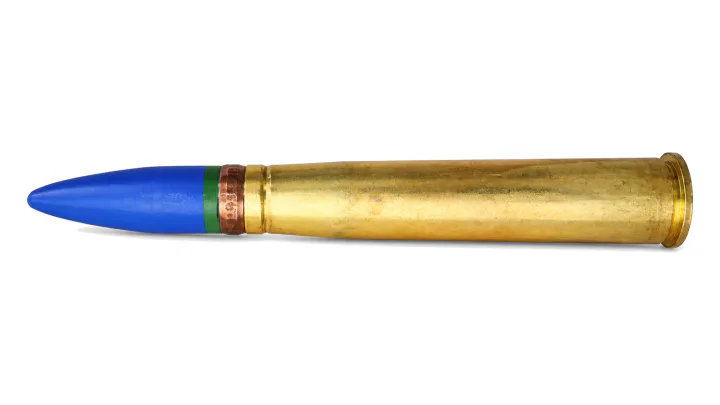
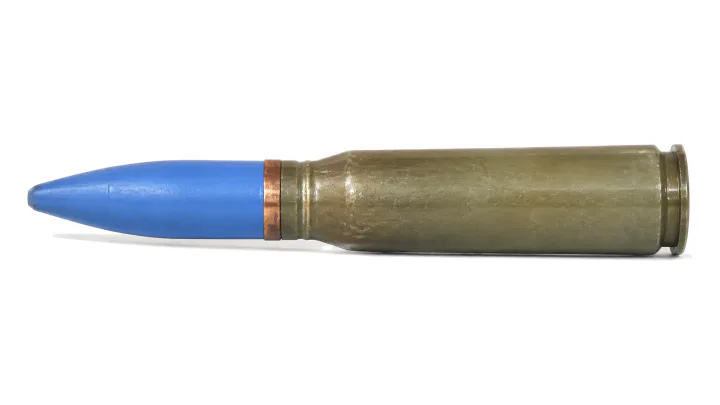
Target practice rounds, medium calibre / medium caliber
Eighteen line items carry the practice nature. Designation families run 20 mm x 102, 20 mm x 110, 20 mm x 110RB, 23 mm x 115, 23 mm x 152B, 30 mm x 165, 30 mm x 173, 40 mm x 311, 40 mm x 365 and 57 mm x 438, in the TP and tracer TP-T suffixes. Every record states a round mass, a muzzle velocity and an operating temperature band, and nearly all add a projectile mass. Two 20 mm x 110 records are written for the 20 mm subcalibre training barrels M78 and M79 rather than for a full-calibre gun.
A 20 mm x 110 training round for the 20 mm subcalibre training barrels M78 and M79 fitted to larger weapons, whose projectile is loaded with flash composition and fitted with a point-detonating fuze with mechanical self-destruction.
A 20 mm x 110 training tracer round for the 20 mm subcalibre training barrels M78 and M79 fitted to larger weapons, whose projectile is loaded with flash and tracer composition and fitted with a point-detonating fuze with mechanical self-destruction.
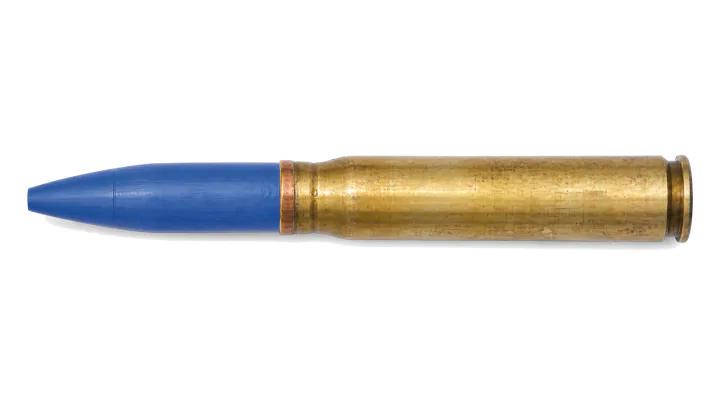
A 20 mm x 110RB target practice round made up of a brass cartridge case with a percussion gun primer, a propellant charge and a target practice projectile, for the 20 mm MK-IV Oerlikon antiaircraft gun.
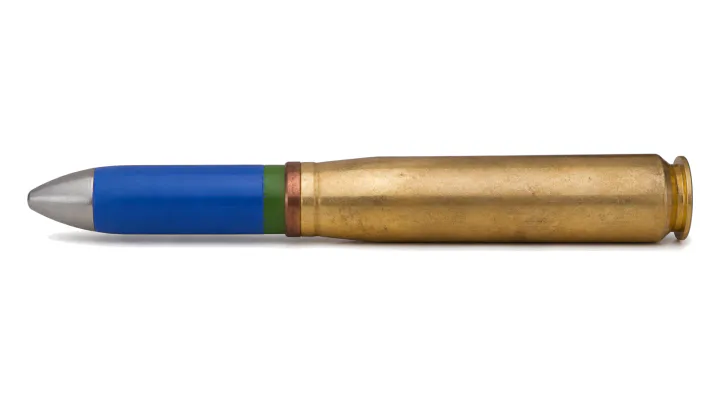
A 23 mm x 115 target practice round for aircraft guns, made up of a brass cartridge case with a percussion gun primer, a propellant charge and a target practice projectile.
A 23 mm x 115 target practice tracer round for aircraft guns, made up of a brass cartridge case with a percussion gun primer, a propellant charge and a target practice projectile filled with tracer composition.
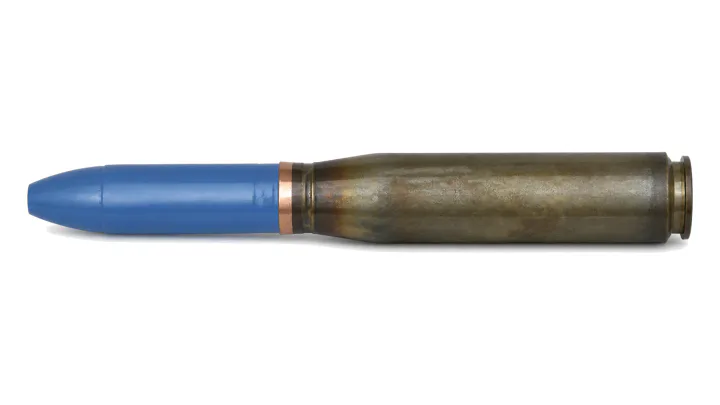
A target practice round for the 23 mm ZU-23-2 and ZSU-23-4 antiaircraft guns, consisting of a steel cartridge case with percussion gun primer, propellant charge and a target practice projectile.
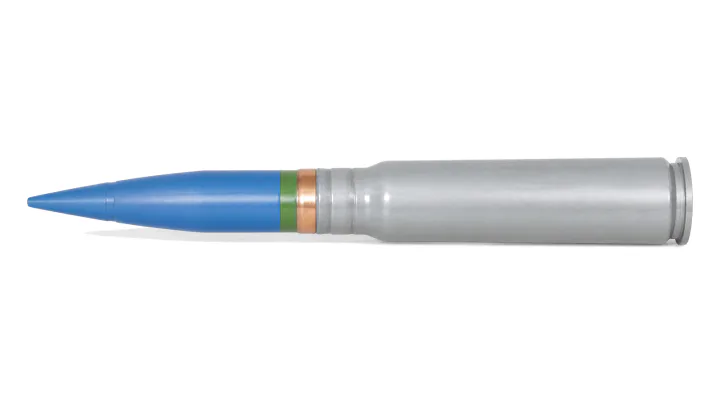
A 30 mm x 165 target practice round for the 2A42, 2A72 and 2A38M antiaircraft guns, consisting of a steel cartridge case with percussion gun primer, propellant charge and a target practice projectile.
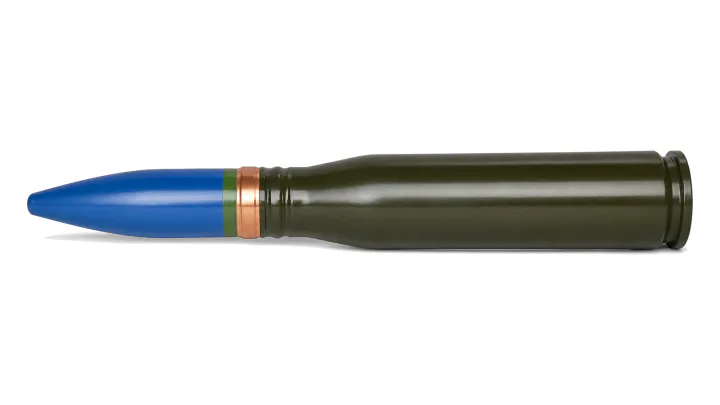
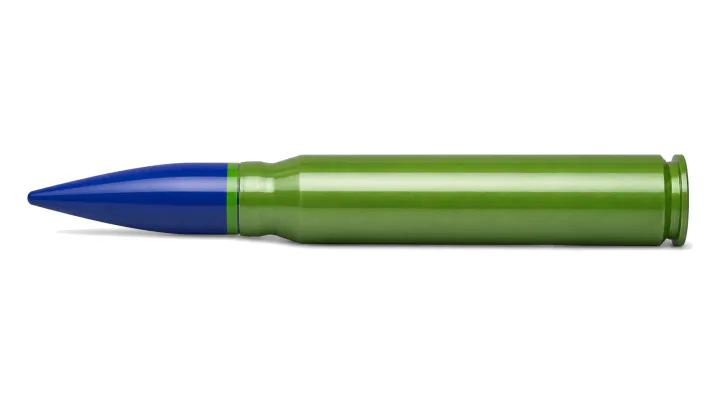
A 30 mm x 173 target practice round for the MK30-2 gun and the domestic 30 mm TA M12 gun, consisting of a steel cartridge case with percussion gun primer and booster, propellant charge and a target practice projectile.
A 30 mm x 173 target practice tracer round for the MK30-2 gun and the domestic 30 mm TA M12 gun, whose low-cost training projectile is a steel shell body with tracer composition and a dummy fuze.
A 40 mm x 311 target practice round for the 40 mm L/60 anti-aircraft gun, consisting of a brass cartridge case with percussion gun primer, propellant charge and a target practice projectile.
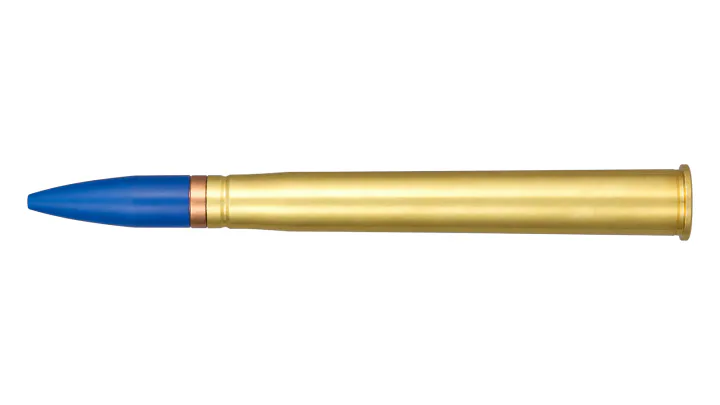
A 57 mm x 438 target practice round for the 57 mm L/70 Bofors antiaircraft gun, consisting of a brass cartridge case with electrical gun primer, propellant charge and a target practice projectile.
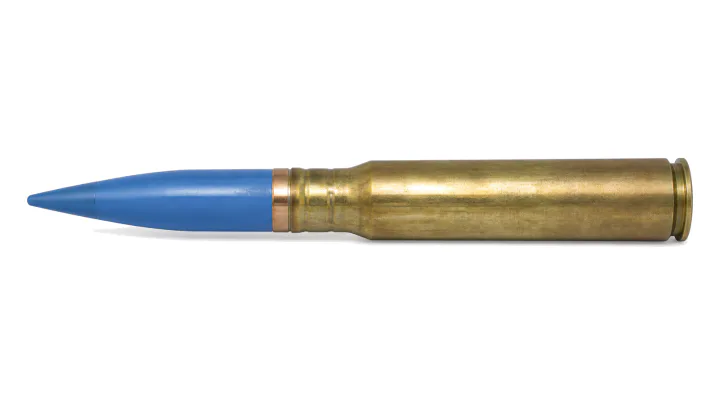
A 20 mm x 102 round with a brass cartridge case, electrical gun primer, propellant charge and a target practice projectile, for the M621, M61A, M39 and M197 guns.
Muzzle velocity
1030±15 m/s
Projectile mass
100±1.7 g
Calibre
20 mm
Specifications →
How practice natures appear in a tender annex
A practice line is quoted against the service round it accompanies, so the schedule shows the same cartridge designation with a TP or TP-T suffix. The fields a buyer compares are round mass, projectile mass, muzzle velocity and maximum gas pressure, since these determine whether the training item follows the same trajectory as the natures it stands in for. Operating temperature limits are stated on every record.
Designation families and what varies by model
TP records a target practice projectile; TP-T adds a tracer composition and, on most records, a burning time, from a minimum of 3 s on the 23 mm x 115 and 30 mm x 165 entries to 4 s on the 40 mm x 365. Construction also varies: the 30 mm x 173 TP-T uses a steel shell body with a dummy fuze, while the subcalibre 20 mm x 110 entries carry flash composition and a point-detonating fuze with mechanical self-destruction.
Questions about this equipment
Are all practice projectiles in this group inert?
No, and the schedule says so. Most TP and TP-T entries describe a plain target practice projectile, but the two 20 mm x 110 records written for the M78 and M79 subcalibre barrels state a flash composition and a point-detonating fuze with mechanical self-destruction.
How is a practice round matched to the service nature?
By the shared cartridge designation and the quoted ballistic figures. The 23 mm x 152B TP-T, for example, states 970 m/s, the muzzle velocity the service natures in that family also record, and a 191 g projectile, the mass given on the 23 mm x 152B HE-T / HEI-T record; the other service natures there run 182 to 189 g.